
Scan
QR-coded booklets run through the ADF scanner you already own — double-blind, no new hardware.
For CBSE Schools & Autonomous Colleges · Tirupati & Hyderabad
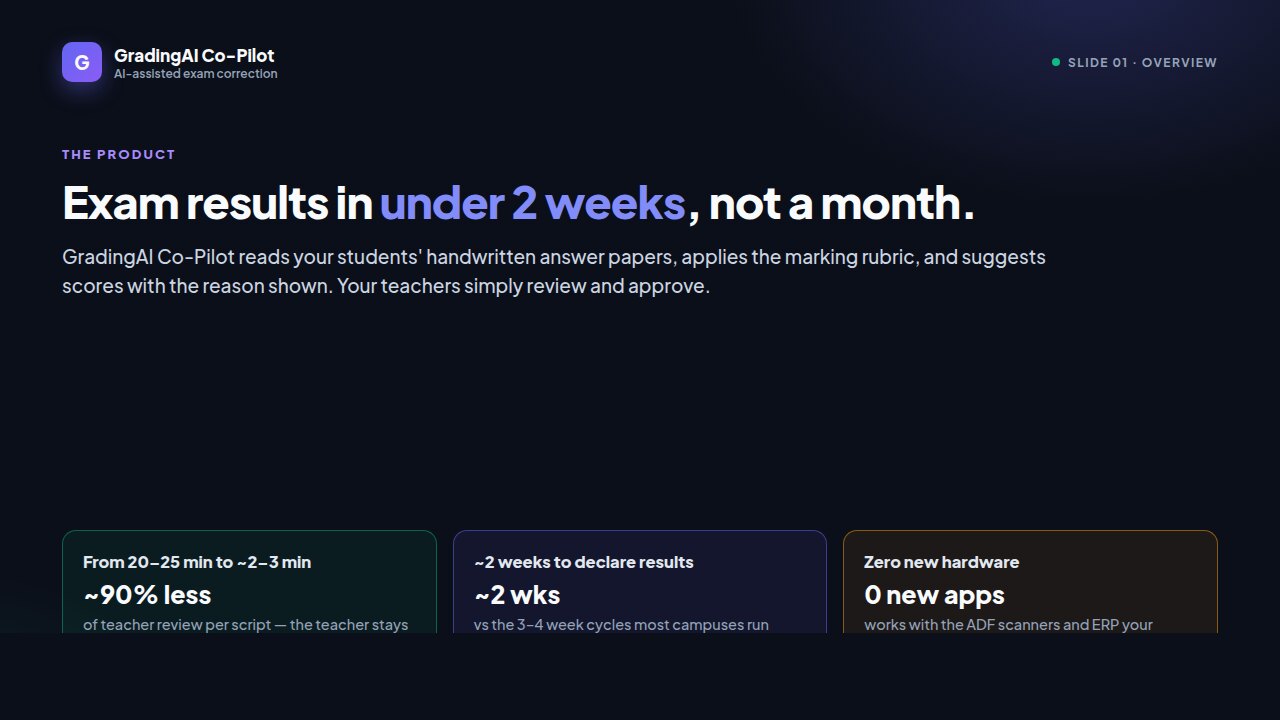
Reads handwriting, applies your rubric, and suggests a score with the reason shown — then your teacher approves in seconds. From 20–25 min → ~2–3 min per script.
Zero new hardware · No new student app · Data stays in India
Two ways to work
Reads every handwritten answer, checks it against the rubric, draws the ticks and crosses on the exact lines, and suggests a score with the reason shown — zero teacher input until review.
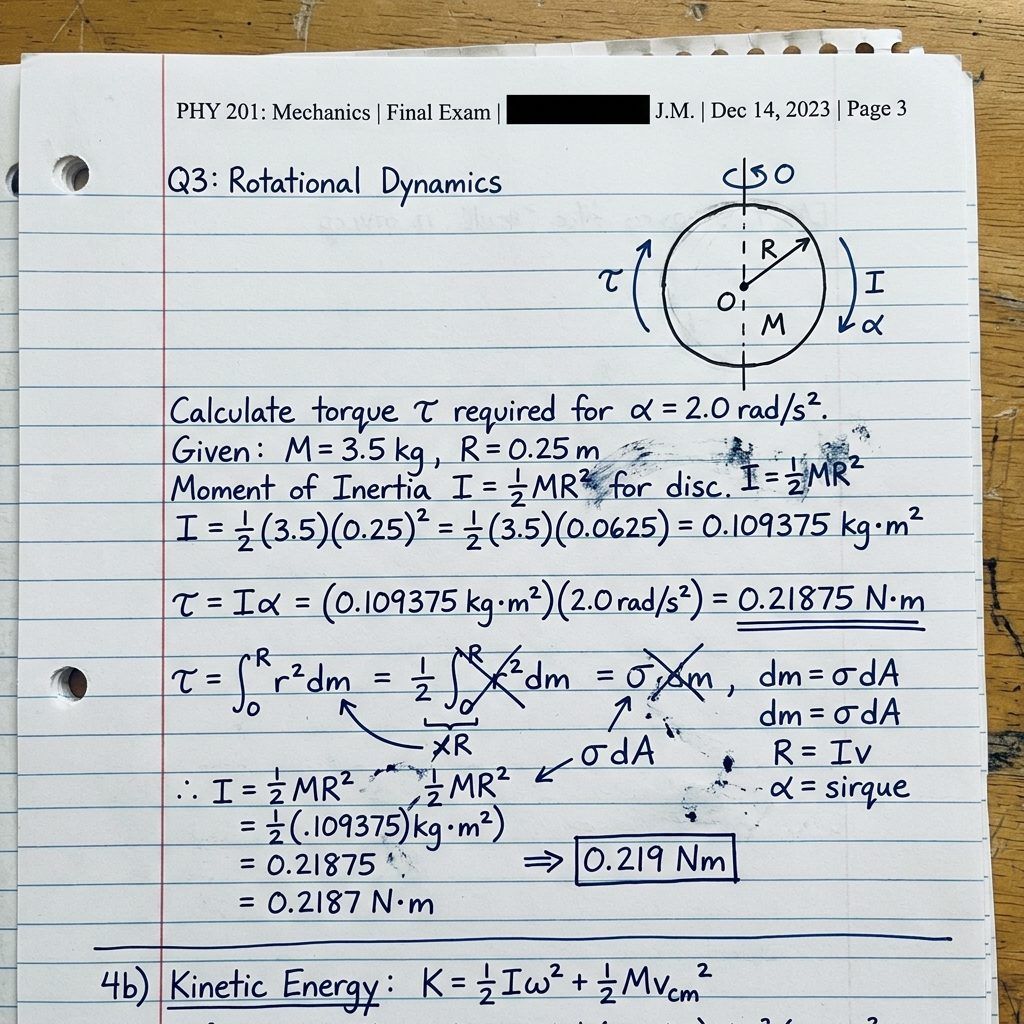
Review a script in seconds, override any score you disagree with, then approve. The score locks, the pen-trail is committed, and it syncs straight to your ERP.
Enter to approve the next page
The hidden cost of paper exams
Slide the toggle to see what a 1,000-student campus changes.
How it works
The machine does the heavy reading. The teacher stays in charge of every final mark.
QR-coded booklets run through the ADF scanner you already own — double-blind, no new hardware.
The model reads messy handwriting, checks the rubric, draws the ticks and suggests a score with the reason shown.
Review in ~2–3 minutes per script, override anything, and hit Approve & Sign Off.
The Evaluator Canvas
AI marks pop in as it reads. Every mark carries a reason — human agreement ~95%.
Product
Roll numbers are unmasked automatically via pre-printed QR codes, so evaluators judge the answer, not the student. No more partiality complaints.
On sign-off, every vector tick and correction is flattened permanently into the PDF — a physical-equivalent record for re-evaluation disputes and legal review.
Each suggested mark is paired with the rubric line it matched. Your teachers see why, so they trust the AI and can override it in one click.
Enter to approve and jump, Tab to override a score,
Ctrl+Z to undo a pen stroke. Clearing a batch becomes a rhythm, not a chore.
Marks and feedback sync into your existing stack — MyCamu, Entab, EduSys or a custom ERP — and show up in the student app they already use.
End-to-end encryption, DPDP-aligned practices and hosting on Indian domestic cloud (E2E Networks / AIC Cloud). Your students' data never leaves the country.
The differentiator
Every corrected paper becomes a personal diagnostic report — so a "17/20" turns into exactly what to study next.
Students ignore static downloads. So we link to videos and build practice they actually attempt — a learning loop that compounds every exam.
• Q3(a): conceptual gap — density integration
• Q4(b): arithmetic slip — 16 × 3
Why not just ChatGPT?
Pasting a paper into Gemini or ChatGPT gets you a guess — not a defensible, batch-wide evaluation. Here's the gap, and why it keeps widening.
Principal / COE view
A teacher spends 20–25 minutes on each descriptive script — most of it re-reading and re-totalling. Calculated monthly, forecast to a year. Adjust the numbers for your campus.
Compliance & privacy
Pricing
Per enrolled student, per month — so the price scales naturally with your total student strength. No surprise setup fees.
₹0/ 100 papers
₹75–100/ student / month
₹100–150/ student / month
The per-student rate decreases as total enrolment grows — a 2,000+ student campus pays less per student than a 300-student school. The exact rate is confirmed after the free pilot.
The offer
Take one recently completed internal mock exam and let us prove the accuracy on your own papers.
Use your existing campus scanner. QR-coded, double-blind, nothing leaves your campus servers.
Three senior faculty try the 1-click evaluation portal on real answer scripts — no training needed.
We compare AI marks vs your corrections, collect teacher feedback, and present the ROI case to your Principal & COE.
Pitch deck
Flip through the complete 16-slide deck we present to principals and COEs — or download it.
FAQ
Our hybrid OCR + vision pipeline is built for Indian handwriting styles and messy scans. Independent evaluations put AI–human agreement at ~95% on descriptive answers — and higher when teachers calibrate the rubric on a sample first. Crucially, nothing is final until a teacher signs off — a misread mark is caught and corrected in seconds, not weeks.
No. It removes ~90% of the correction time that is re-reading, re-totalling and writing the same comments — turning ~20–25 minutes per script into ~2–3 minutes of review. Teachers keep full authority over every mark and gain time for actual teaching.
No. We integrate with your existing ERP and student app through REST APIs and webhooks. Teachers and students stay in the tools they already use.
No. We work with the ADF scanners campuses already own — Canon, Fujitsu, Epson — via standard TWAIN/WIA drivers, with automatic deskew, contrast and blank-page discarding.
Per enrolled student, per month, billed for the academic year. Schools pay ₹75–100 per student/month and universities slightly more; the per-student rate drops as total student strength grows. You only start paying after a free 100-paper pilot confirms the value on your own scripts.
On Indian domestic cloud infrastructure (E2E Networks / AIC Cloud), encrypted in transit and at rest, and aligned with DPDP 2023 requirements. We can also run fully on-prem for sensitive campuses.
Yes. Every tick, score and override is permanently flattened into the PDF at sign-off, creating a physical-equivalent audit trail that stands up in re-evaluation and legal review.
ChatGPT and Gemini are general-purpose chatbots: paste a paper and you get a guess — no rubric, no per-question mark breakdown, no double-blind masking, and nothing you could defend in court. GradingAI is built around the exam office: a rubric engine that shows the reason for every mark, teacher sign-off, a flattened pen-mark PDF for disputes, and ERP integration. It's a grading system, not a chat window.
Anyone can build a vision model. The moat is the feedback loop: every mark your teachers approve or override re-calibrates our rubric to your syllabus, your past papers and your students' handwriting. Accuracy compounds with every exam we grade for you, and a competitor starting today has zero grading history on your campus. Switching away means throwing away that calibrated accuracy.
Grades alone are static — the loop is what compounds value. A corrected paper becomes a diagnostic report, which pinpoints the exact sub-topics a student failed, which drives targeted teaching, which shows up in the next exam — and every step gives the AI cleaner signal. It turns a one-time correction service into an asset that gets smarter every term.
Let's talk
Pick a time for a 20-minute call or campus visit. We'll bring the demo, the deck and a pilot plan for your next internal exam.
Serving CBSE schools & autonomous colleges in Tirupati, Hyderabad and Telangana / Andhra Pradesh.